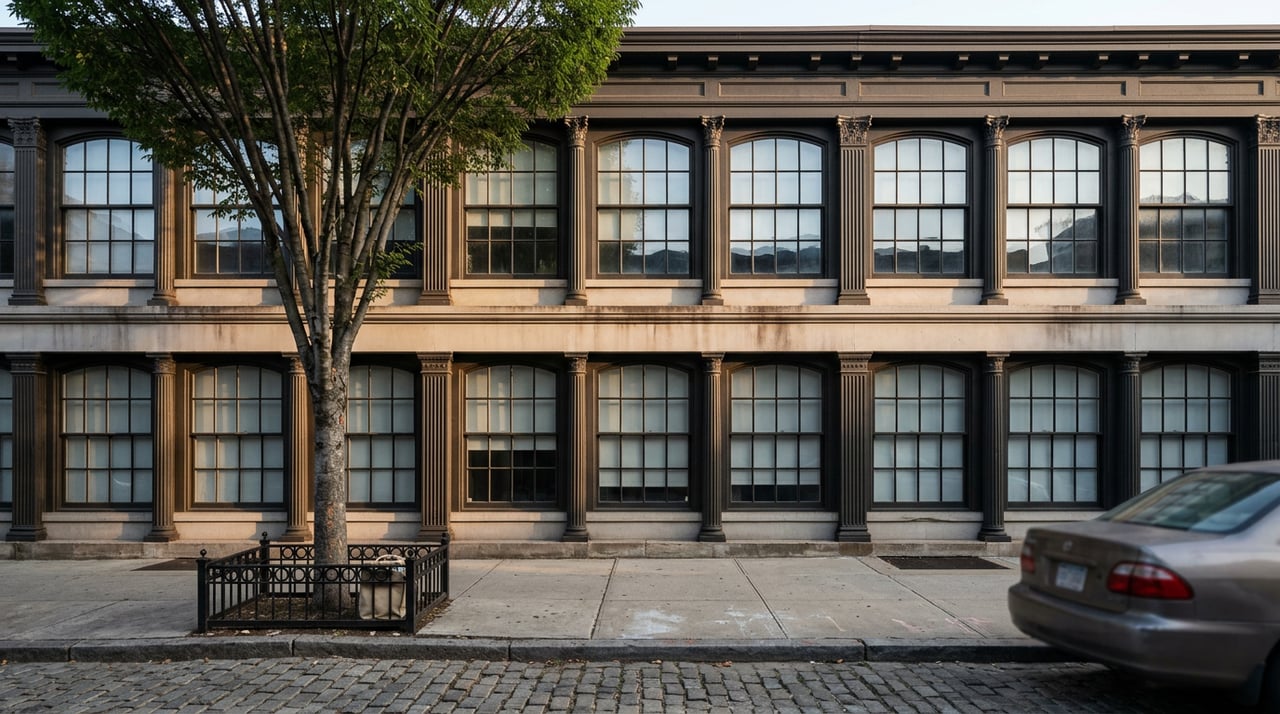
"the ancient subway scene in 'Beneath the Planet of the Apes.'"
That's how one Tribeca Citizen reader described the platform at the Chambers Street J/Z station this month, and anyone who has waited for a train there in the last decade knows exactly what he meant. Tile is missing in patches. Water pools where the ceiling has given up. It is the kind of decay that gets attention for being decay, not for being interesting.
This fall, that finally changes. And the story of how it changes tells you more about how Tribeca actually operates than any new restaurant lease could.
Chambers Street opened in 1913 as part of the old BMT Nassau Loop and was added to the National Register of Historic Places in 2005, back when its mosaic plaques and terra cotta detailing were still legible. The renovation that would restore all of that was first floated in a 2020-2024 MTA capital plan, then paused when congestion pricing looked like it might get cancelled. It came back on in January 2026, and this month Governor Hochul's office and the MTA confirmed the state is now seeking a contractor for a full rehabilitation, funded by congestion pricing revenue and expected to be awarded by the end of this year.
The scope is not cosmetic. The plan calls for restoring ceramic tiles, mosaics, and marble bases, replacing damaged stairs, building new track walls, and installing new lighting and camera systems, alongside a feasibility study on geothermal heat pumps that would cool the station in summer and vent that heat into nearby buildings in winter. The station serves 18,196 riders on an average weekday, which is a lot of people who have spent years walking past crumbling tilework on their way to the 4/5/6 or the ferry.
None of this is glamorous. It is also the single most consequential thing happening to the neighborhood's daily rhythm this season, and it happened because a stalled six-year-old capital project finally got its funding sorted out. That is the Tribeca pattern worth noticing: the neighborhood's biggest fall stories are not launches, they are things that were already promised finally landing.
The small business turnover this season follows the same logic. Nothing here is a hot debut chasing a soft opening party. It is continuity, in both directions.
| What's changing | Where | Why it matters |
|---|---|---|
| Amare Pilates | Gibbes Building, West Broadway | Opened by Tribecan Marina Enright inside a 19th-century building, not a new construction shell |
| Tutu School | Neighborhood location | Targeting a September 14 reopening after a stretch offline |
| Mezze on the River | Gateway Plaza, Battery Park City | Closing permanently, not from underperformance but because the Battery Park City Authority has construction underway for the next two and a half years |
| Chambers Street J/Z | BMT Nassau Loop station | Contractor selection underway now, full restoration to follow over roughly two years |
Read that table straight through and the pattern holds. A Pilates studio takes over space in a building that has stood since the 1800s. A children's dance school works its way back onto the calendar. A waterfront restaurant closes not because Tribecans stopped eating there, but because the authority that owns the ground underneath it started a multi-year infrastructure project. Even the closures here are about construction schedules, not concepts that failed.
If there is one place actually adding something new to the neighborhood's calendar, it is Tribeca Performing Arts Center on Duane Street, and even there the addition is range rather than novelty.
The fall lineup includes:
That is a classic rock tribute, a children's circus act, an experimental dance workshop, and a storytelling event tied to the neighborhood's own founding trauma, all inside a two-month window at the same venue. It is not a calendar built around one audience. It is a venue old enough and established enough to book for several audiences in the same season without diluting any of them, which is its own kind of institutional maturity.
Tribeca's Halloween traditions follow the same continuity thread, and they are worth understanding precisely because they do not change.
At 21 Jay Street, the annual haunted display returns each October, built by Worth a Shot Events with sound effects and increasingly elaborate props. Past years have included a rearing horse and, one memorable October, an inflatable corn maze that closed off the block entirely. It is a private storefront tradition that has run long enough to become a fixed point on the neighborhood's calendar without any organization or sponsorship behind it beyond the shop owners themselves.
A few blocks away, the Friends of Washington Market Park run the neighborhood's official Halloween weekend: a Pumpkin Carving Contest judged by a rotating panel that last year included the NYC Parks Manhattan Borough Commissioner, City Councilman Chris Marte, the principal of PS 150, and the co-founder of Downtown Dance Factory, with the NYC Parks Commissioner making a surprise appearance to hand out trophies. The parade that follows has been led by the Queer Big Apple Corps since 2012, drawing hundreds of neighbors to a contest that added a sixth category last year, master blade, for the professional carvers.
None of this is new this year. That is the point. The people organizing it are largely the same people who organized it last year and the year before. The continuity is the draw, not a discovery.
Put the station, the storefronts, the PAC calendar, and the Halloween parade next to each other and a single idea holds all of it together: Tribeca's fall this year is defined by things that were already in motion finally arriving on schedule, run by the same institutions and the same people who have always run them. A subway station stuck in a six-year funding limbo gets its contractor. A Pilates studio moves into a building that predates the subway station itself. A children's dance school picks up where it left off. A parade tradition that started in 2012 does what it always does. Even the one restaurant closing this season is closing because of a construction timeline, not a concept that stopped working.
That is a different kind of neighborhood story than the one told about new leases and soft openings elsewhere downtown. It is also, if you live here, probably closer to how the season will actually feel.
If the way a neighborhood actually runs, its infrastructure timelines, its institutional continuity, its quieter turnover, is the kind of detail that matters to you when you think about Tribeca, that is exactly the read Tony Sargent brings to every conversation about the neighborhood. Schedule a Confidential Consultation to talk through what's ahead.
Compass
110 5th Avenue, 3rd Floor New York, NY 10011