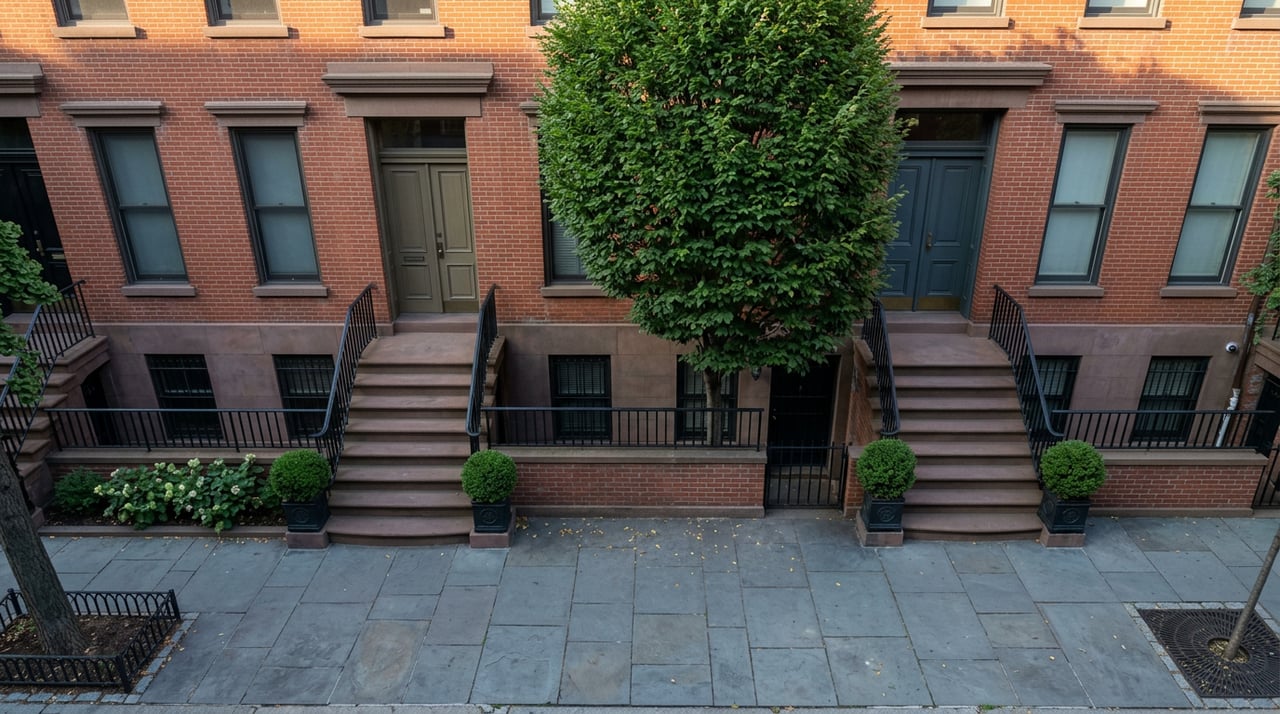
In October 2025, a construction firm called J.T. Magen & Company paid $10.25 million for a five-story walkup at 80 Horatio Street, working out to roughly $1,671 per square foot. The building dates to 1853 and currently holds eight units. The plan was straightforward: convert it into a single-family mansion. Nearly a year later, that plan is still waiting on a stamp from the Landmarks Preservation Commission, which split over one detail in August and is scheduled to revisit a revised design on September 1, 2026. The sticking point isn't the mansion. It's whether a storefront installed in a 1909 alteration, on a building that's stood since 1853, gets to disappear.
That single dispute tells you more about how West Village pricing actually works than any median you'll find on a portal. The neighborhood doesn't have one real estate market. It has three, and they run on different rules, different supply constraints, and increasingly, different price trajectories in the same month.
Look at May 2026. Condo sale prices in the West Village rose 16.9 percent year over year, landing at a median of $4.3 million. Co-op sale prices, tracked in the same data set for the same month, fell 28.8 percent to a median of $825,000. That's not noise. That's two different products responding to two different sets of buyers, moving in opposite directions inside a neighborhood small enough to walk end to end in twenty minutes.
A blended headline figure, the kind most portals report, averages those two stories into something that describes neither. If you're comparing the West Village to another neighborhood using one number, you're comparing a mix that no actual buyer experiences. Nobody shops condos and co-ops interchangeably here. The financing is different, the board process is different, and increasingly, the price direction is different.
Here's roughly how the segmentation breaks down based on current inventory and recent closings:
| Tier | Typical price per square foot | What defines it |
|---|---|---|
| New-development and boutique condos | $2,500 to $4,000+, with penthouse asks well above that | Fee-simple ownership, limited to a handful of converted commercial buildings and ground-up towers |
| Landmarked townhouses | $1,500 to $2,500 (co-op-owned units), full-building trades in the $8 million to $30 million+ range | Federal and Greek Revival rowhouses on protected blocks, often subdivided into two to four units |
| Prewar elevator-building co-ops | $1,200 to $2,000 | Larger buildings with doormen and staff, priced 20 to 30 percent below comparable condos, consistent with the co-op discount seen across Manhattan |
The condo tier is where you find the numbers that make headlines. Eighty Clarkson, a 113-unit tower from Zeckendorf Development and Atlas Capital Group, has an estimated sellout north of $2 billion. One penthouse there has been asking $80 million, or more than $11,235 per square foot. A few blocks away, at the Herzog and de Meuron-designed 160 Leroy Street, Justin and Hailey Bieber bought a 2,800-square-foot condo for $12 million, which pencils out to roughly $4,286 per square foot for a four-bedroom with Hudson River views. In late August, The Real Deal reported one closed deal in the neighborhood at more than $10,000 per square foot.
The townhouse tier runs on a completely separate logic. A 22-foot-wide, four-story house at 27 Perry Street is currently asking $11.95 million, with a detail no condo can offer: a private horse walk running to St. John's Colony gardens, a shared courtyard tucked behind the block. You're not paying for square footage there. You're paying for a piece of streetscape that can't be replicated, which is precisely why the Landmarks Preservation Commission cares so much about what happens to buildings like it.
The co-op tier is where affordability still exists, relatively speaking. A prewar unit in a full-service elevator building can trade at half the per-square-foot price of a new condo a few blocks away, because the ownership structure, board approval process, and building age all filter out a different pool of buyers.
The reason these three tiers don't converge over time comes down to a zoning mechanic that most buyers never hear about until they're deep into a deal. Roughly 80 percent of the West Village sits inside the Greenwich Village Historic District, designated by the Landmarks Preservation Commission in 1969 and, for four decades afterward, the largest historic district in the city. Inside that boundary, owners of historic-district buildings cannot transfer unused development rights the way an individual landmark can. That single rule is why new condo supply stays scarce almost by design. There's no mechanism for a developer to assemble air rights across a block of protected townhouses and build up. The roughly 1,000 protected townhouses on blocks like Bank, Bethune, Charles, Bedford, Commerce, Grove, and Perry Streets simply aren't going anywhere, and neither is the square footage they represent.
The 80 Horatio Street filing shows this in miniature. The lot measures 24 feet by 87 feet, about 2,145 square feet, zoned R6 with a maximum floor area ratio of 2.43. Do the math and that zoning would allow roughly 5,200 square feet of construction. The building already holds 6,133 square feet, grandfathered in from an earlier code. There's no legal path to add bulk here even if an owner wanted to, and no way to move that excess capacity to another site the way a Midtown developer might trade air rights between towers. The building is what it is. The only lever left is what gets restored, replaced, or repainted on the surface, which is exactly what's tying up the LPC hearing.
That's the mechanism condo buyers don't compete against and townhouse buyers can't escape. It's also why co-op prices can soften in a given month without dragging the townhouse tier down with them. The two markets don't share supply, so they don't share a price cycle either.
If you're using price per square foot to compare the West Village against Tribeca, Chelsea, or the Upper West Side, the number you pull needs a second question attached to it: which of the three West Village markets does that figure actually describe? A $2,500 per square foot condo comp tells you nothing useful about what a townhouse on Bedford Street will cost you, and a co-op closing at $1,400 per square foot doesn't predict what you'll pay for new construction near the waterfront.
The more useful exercise is deciding which tier fits your actual plans before you start pulling comps. A buyer who wants turnkey space and doesn't mind a board interview should be pricing against the co-op tier, not the condo headlines. A buyer drawn to the neighborhood's architecture, and willing to accept that any exterior change runs through a commission review, should study recent townhouse trades on the specific block they're considering, not a neighborhood-wide average. And a buyer chasing fee-simple ownership and modern systems should understand that the condo tier's scarcity is not a temporary supply gap. It's a permanent feature of a zoning structure that isn't changing.
Does landmark status hurt resale value in the West Village? The historic district restricts what an owner can change on the exterior, but that same restriction is what keeps the streetscape intact, which is a large part of why buyers pay a premium for these blocks in the first place. The trade-off shows up in renovation timelines and cost, not typically in long-term demand.
Will new condo supply ever loosen this market? Not within the historic district boundary. Because development rights can't be transferred out of historic-district structures, there's no zoning path for the kind of assemblage that adds new condo towers. Any future condo supply is more likely to come from the conversion of an existing building, like the eight-unit-to-one-family plan at 80 Horatio Street, rather than new ground-up construction.
Why did co-op and condo prices move in opposite directions in the same month? Because they're not competing for the same buyers or financing. Co-op boards vet buyers financially in ways that filter out cash-tight purchasers, which can slow or soften that segment during periods when mortgage-dependent buyers pull back. Condo buyers, who skew more cash-heavy and international, kept bidding on the scarce fee-simple product even as co-op activity cooled.
Comparing neighborhoods on a single number will always miss what's actually for sale. If you want a read on which West Village tier fits your search, and access to the off-market and pre-market opportunities that rarely show up in any of these figures, Tony Sargent is a good place to start that conversation. Schedule a Confidential Consultation.
Compass
110 5th Avenue, 3rd Floor New York, NY 10011